

Guide
Using the tree viewer
rcf audit view serves the document chain as a live, read-only review surface in your browser. This page is how to work it.
The tree viewer is where you read what your agent has written. Reviewing the tree covers what to look for and what to push back on; this page covers the tool itself.
rcf audit view
That starts a local HTTP server, at http://127.0.0.1:4373/ by default, rendering the on-disk chain under rcf/ as a tabbed review surface. It is read-only and writes nothing to disk: no static files, no export. The server watches rcf/ and streams every change to the open browser tab as it happens, so the standard way to use it is to leave it running while your agent works and watch the tree fill in.
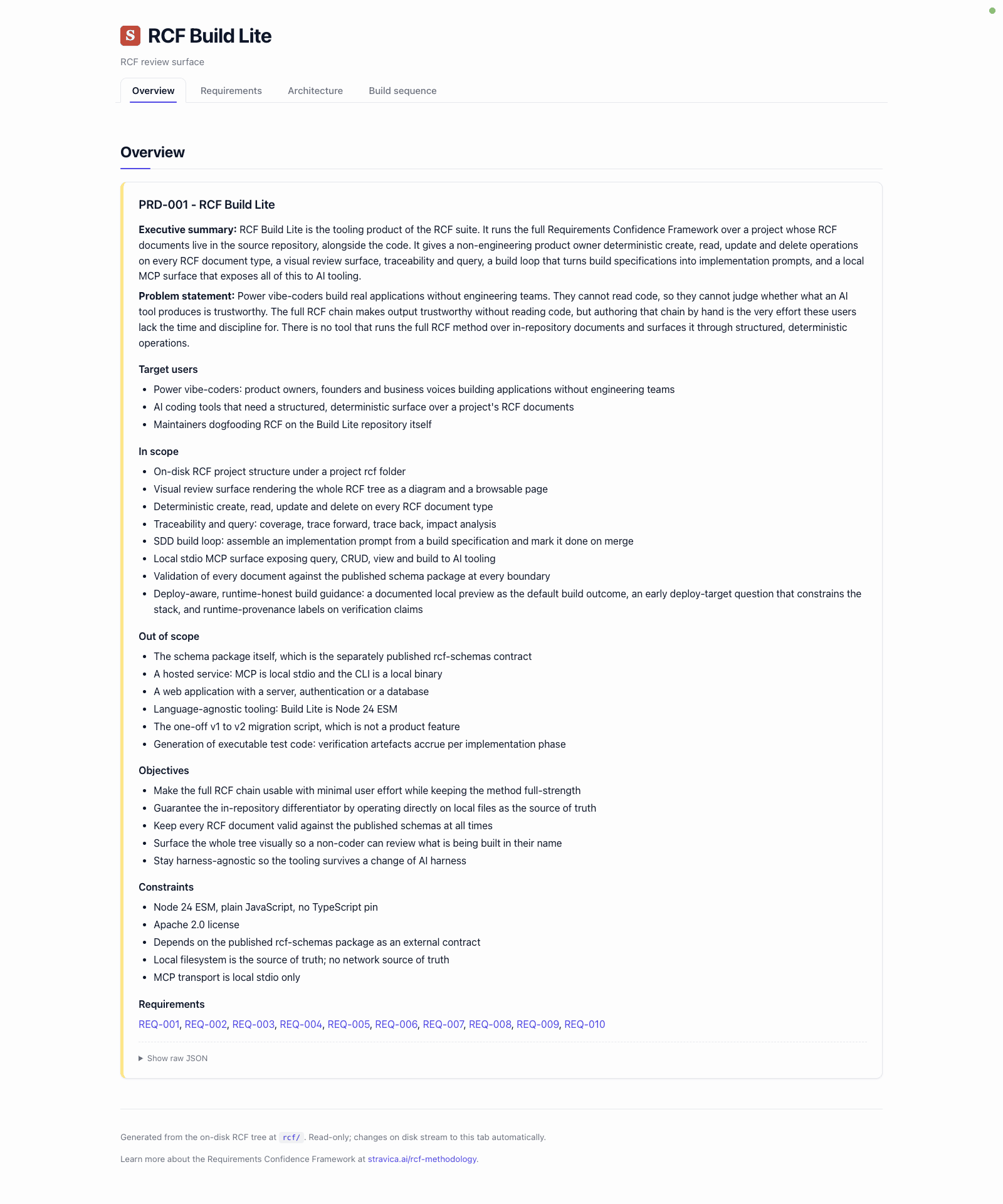
The four tabs
- Overview. The PRD body: the problem statement, the objectives, and a summary of the requirements hanging off it, with a slice diagram per requirement.
- Requirements. The full requirement chain: each requirement with its user stories and their acceptance criteria.
- Architecture. The technical architecture document, the components (TACs) with their responsibilities, and the architectural decision records (ADRs).
- Build sequence. The build queue in order: each FBS slot with its execution status, and each specification with the acceptance criteria it delivers.
If JavaScript is unavailable, the tab bar becomes chrome and the four panels render stacked on one page. Nothing is lost, only the switching.
Local only, no auth
The server binds 127.0.0.1 only and has no authentication. It is for you, on your machine, and that is the whole security model: do not tunnel, proxy or port-forward it anywhere.
Ports
The default port is 4373. --port <n> beats the RCF_VIEW_PORT environment variable, which beats the default. A busy port is a hard failure, exit 2, not a silent fallback to another port.
rcf audit view --port 4500
Running it for longer than a terminal session
Plain rcf audit view runs in the foreground; its lifetime is your terminal session and Ctrl-C shuts it down. When the review outlives the terminal, the start subverb runs a supervised background server instead:
rcf audit view start --detach --persist-until 4h
rcf audit view status
rcf audit view stop
--persist-until takes a duration (4h, 30m, 2h30m) or an ISO timestamp; a value it does not recognise is refused rather than left running forever. status reports running, stale or not-started, logs prints the server's log tail, and stop shuts the background server down cleanly. On an interactive terminal, start detaches by default; in a script it stays in the foreground so nothing gets orphaned.
Stop the server when the review is done. It costs little to run, but an unattended local server with your project's full requirements tree on it is not something to leave up out of habit.
Where this leaves you
The viewer shows you the tree; the judgement about whether the tree captures what you meant is yours, and Reviewing the tree is the craft of making it. The verbs behind the other mechanical questions, coverage, trace and impact, are in the CLI reference.